
What We See on a Typical Call
The call usually sounds the same: the homeowner hits the button, the door rolls down a foot or two, then jerks back up on its own. Or it won't move downward at all, the opener just hums or clicks. By the time we get to the house, most people have already tried the remote, the wall button, and unplugging the opener once for good measure. The door still does the same thing. In Arcadia and the surrounding DeSoto County area, this kind of call picks up after a stretch of heavy rain or a hot, humid week, because moisture and swelling play a bigger role here than in drier climates.
The Symptoms Worth Noting Before We Arrive
If you're dealing with this, pay attention to the details below. They tell a technician a lot before a single tool comes out of the truck.
- Door reverses at the same spot every time versus at random points
- Door reverses only when something (a leaf, a shadow, a pet) crosses the sensor beam
- Door won't move down at all, with the opener motor running or silent
- Reversal happens only in bright afternoon sun or only after dark
- Door is noisier or slower than usual right before the reversing started
Causes, in the Order a Technician Checks Them
1. Safety Sensors (Photo Eyes)
This is the first thing we check, because it's the most common cause by far and the quickest to confirm. The two small sensor eyes near the bottom of the tracks have to be aimed at each other exactly. If one gets bumped by a bike, a garden tool, or a car bumper, the beam breaks and the opener reverses the door as a safety response. Afternoon downpours and humidity add another wrinkle: condensation or a film of dust and pollen on the lenses can scatter the beam enough to cause intermittent reversing, especially in direct sun. The fix is usually simple, wipe the lenses, realign the brackets so both LED indicator lights glow steady instead of flickering, and tighten the mounting screws so they can't drift again.
2. Obstructions in the Track or on the Floor
Next, we check the full length of both tracks for anything blocking travel: a dropped toy, a buildup of grit, or a rock kicked in from the driveway. In homes near unpaved stretches or storm runoff areas, small debris that washes in after heavy rain is a frequent culprit. We also check the floor at the door's base for wear in the weatherstripping that could be catching.
3. Track Alignment and Rust
Humidity and salt-tinged air, especially for homes closer to the coast, speed up corrosion on steel tracks and rollers. A track that's rusted or bent even slightly out of alignment creates drag the opener's logic reads as resistance, and it reverses to avoid forcing the door through a jam. We check for gaps between the rollers and the track, listen for grinding, and look for rust flaking at the mounting brackets. A track knocked out of alignment can often be adjusted back into place; a track that's rusted through needs replacement.
4. Opener Force and Limit Settings
If the sensors and tracks check out, we move to the opener itself. Every garage door opener has a close-force setting and a travel-limit setting. If the limit is set too aggressively, the opener thinks the door has hit the floor before it actually has, and it reverses. If the force setting is too sensitive, normal resistance from a slightly swollen wood door panel, common after a humid stretch, can trigger a false reversal. These settings can drift over time or get knocked off after a power outage or a battery backup kicking in. Recalibrating them takes a few minutes with the opener's control panel.
5. Springs, Cables, and Rollers
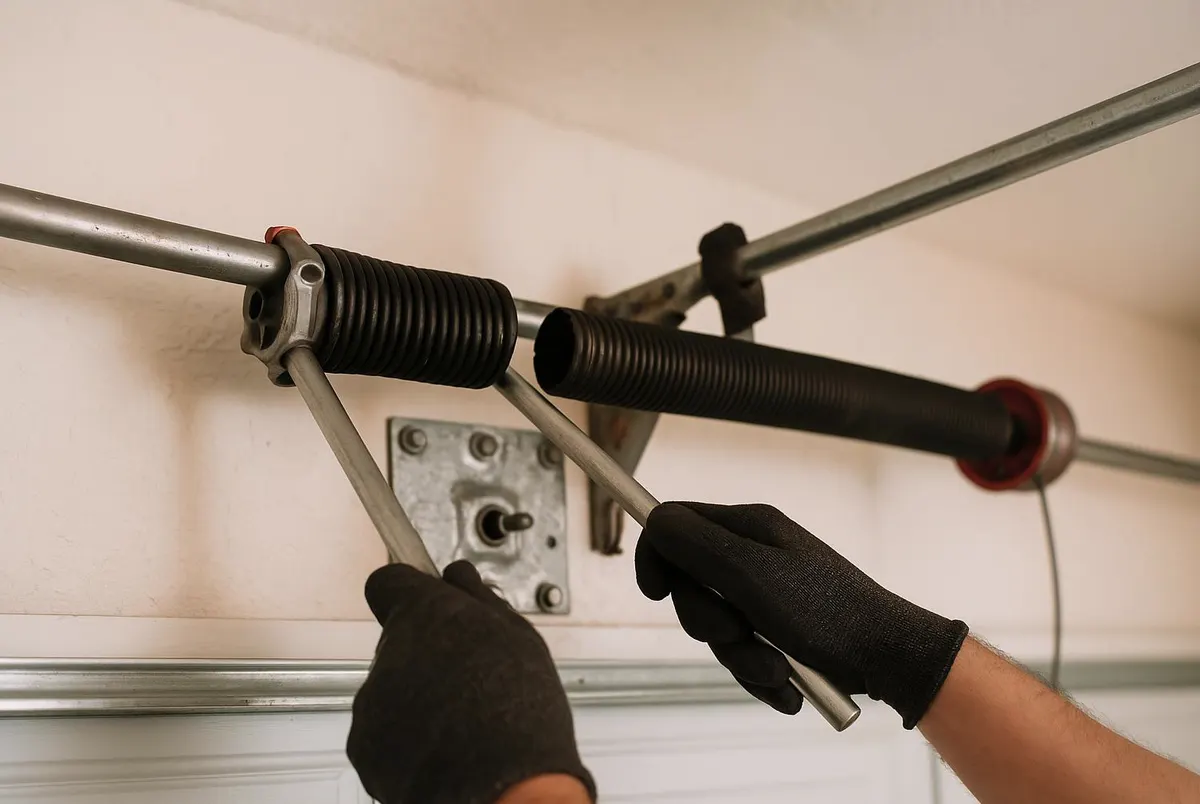
When a door won't close at all, or reverses with a jerky, uneven motion rather than a clean stop, the problem often isn't the opener's judgment, it's a mechanical fight. A weakening torsion spring, a fraying cable, or a seized roller makes the door heavier or lopsided on one side. The opener senses the extra strain, reads it as an obstruction, and reverses or stalls to protect its motor. Rollers that have rusted in place from sustained humidity are a frequent find on older installations. This is also the point where we check that the door's hardware is still rated for the wind-load requirements common to this part of Florida, since an older or mismatched spring system can struggle under that stress long before hurricane season puts it to the real test.
6. Wiring and the Logic Board
Last on the list, because it's the least common, is the wiring between the sensors and the opener, or a fault in the opener's control board itself. Chewed wire insulation, a loose wire nut, or corrosion at a connector, all more likely in a humid garage, can cause the same symptoms as a dirty sensor lens, just harder to spot. If every mechanical and sensor check comes back clean, this is where we look next.
When to Call Arcadia Overhead Door Co
If you've wiped the sensors, cleared the tracks, and the door still won't close reliably, it's time to call. We'll run through Cable & Roller Replacement where corrosion or fraying is the issue, or handle Garage Door Opener Installation if the existing unit's logic board or force settings are no longer trustworthy. Either way, we diagnose in the order above so you're not paying to replace a part that wasn't the problem.
If your garage door in Arcadia, FL is reversing, stalling, or refusing to close, call Arcadia Overhead Door Co and we'll get it closing the way it should.